REF launches “GreenTech Teaching Champions” to connect Education, Employment and Leadership in Slovakia’s Green Transition
Posted on March 31, 2026 by admin3
PRESS RELEASE | Bratislava, Slovakia, March 31st, 2026
Roma Education Fund (REF) announces the launch of the “GreenTech Teaching Champions” project, a four-year initiative focused on aligning education with labour market opportunities and strengthening long-term community resilience in Slovakia. Supported by the Villum Foundation, the project has a total budget of approximately €1.13 million. The project is implemented with the advisory support of Roma Entrepreneurship Development Initiative (REDI Slovakia) team, leveraging their expertise in green economy business development and entrepreneurship.
Implemented gradually in the regions of Prešov, and later in Košice, and Banská Bystrica, the project responds to a structural challenge across Europe: education systems continue to produce learning outcomes that are insufficiently connected to real economic opportunities, particularly for young people from marginalized Roma communities. “GreenTech Teaching Champions” addresses this gap through a systemic approach that connects learning, employment, and long-term leadership.
“The green transition requires every talent available, including those often overlooked. Ultimately, we want to put Roma students at the forefront of technological innovation, far from the image of cheap labourers. This project also marks a strategic evolution for REF. We are moving beyond individual support or local interventions to work directly with the system, ensuring that inclusive pedagogy and green tech expertise become permanent features of vocational education,” says Stanislav Daniel, director of REF Slovakia.
The project places teachers at the centre of transformation. Through a newly established GreenTech Hub in Prešov, complemented by satellite labs in Košice and Banská Bystrica in later phase of the project, vocational teachers will co-develop and complete accredited training modules in green technologies (renewable energy and IoT), inclusive pedagogy, and business and entrepreneurial skills. This is not only about upgrading technical knowledge. It is about redefining how education functions, embedding inclusion, critical thinking, and real-world applicability into everyday teaching practice.
The initiative also establishes a direct link between education and the labour market. Employers are integrated into a continuous quality assurance loop, ensuring that the skills developed in classrooms reflect real economic demand. This creates a clear pathway from training to employment, positioning students, particularly those from Roma communities, as active participants in the green economy transition.
At the same time, the project is designed to generate long-term system impact. A core group of “Teaching Champions” will be trained to transfer knowledge across institutions, while the accreditation of the developed modules, particularly in inclusive pedagogy, anchors these approaches within Slovakia’s national teacher training system. This ensures that impact extends beyond the project itself and becomes embedded in public structures.
REF Slovakia leads the implementation of the project, coordinating partners and stakeholders across institutional levels, including self-governing regions, national authorities, universities, and private sector actors.
Through this initiative, REF advances its strategic vision of building resilient Roma communities through education by moving beyond access towards competence, economic participation, and leadership. “GreenTech Teaching Champions” is not only a project. It is a model for how education systems can evolve: from delivering knowledge to enabling agency, economic validation, and long-term societal impact.
They Don’t See Us Yet | Roma Children at the Edge of Europe’s Digital Future
Posted on November 13, 2025 by admin3
An editorial signed by Stanislav Daniel, team leader for Complementary Education Centres (CECs)
Eighteen years ago, on 13 November 2007, the European Court of Human Rights declared that Roma children in the Czech Republic had been systematically placed in inferior schools. D.H. and Others v. Czech Republic was supposed to mark a turning point, the moment Europe finally saw what it had long chosen to ignore. The Court called it discrimination. For a while, it felt like the wall between “them” and “us” had cracked.
After D.H., governments promised integration plans, inclusive testing, better teacher training. Authorities focused heavily on the ethnic mix in the classroom, often ignoring ethnic composition of the town or the demographics of the village. Today, 18 years after the court ruling, Roma children across Europe are still overrepresented in special schools or segregated classrooms providing education below standards. The lesson from that case was never only about education. It was about recognition. You cannot change what you refuse to see
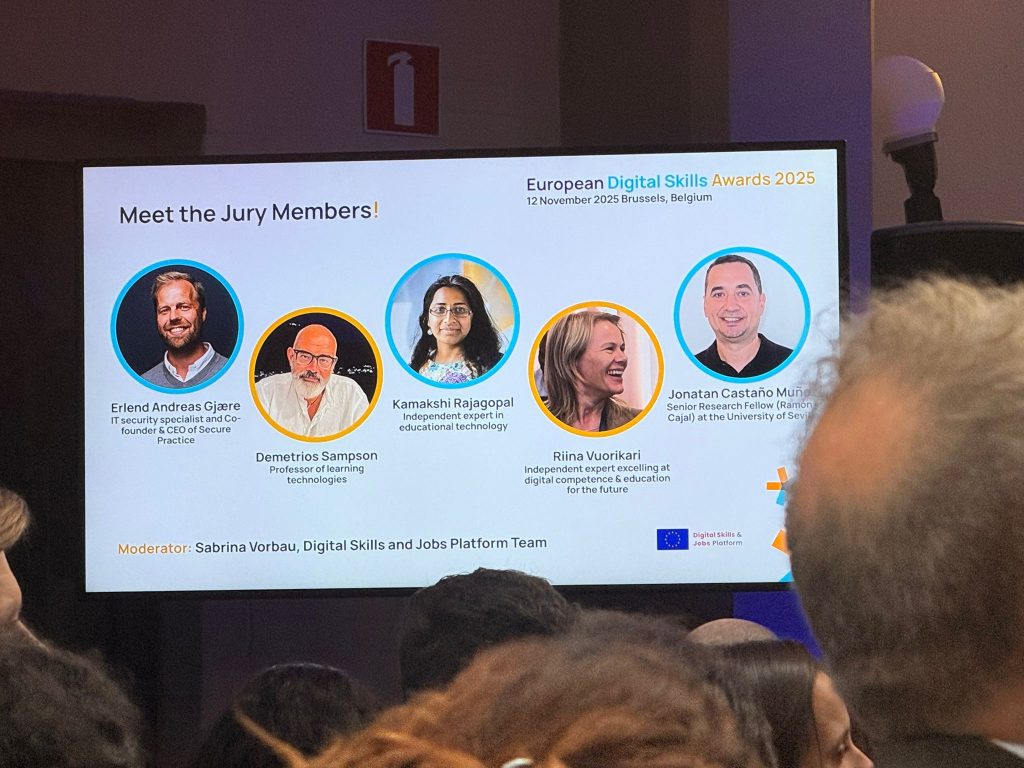
Yesterday (November12) at a conference on digital skills and inclusion, I listened to speaker after speaker talk about “digital skills for all.” Under the theme of inclusion, they spoke about grandparents learning to make video calls, about rural pensioners discovering online banking, about the miracle of access. No one mentioned Roma. No one spoke about the children growing up in neighborhoods where the internet still comes in bursts of signal, where laptops arrive as donations instead of expectations, and where the digital future is still someone else’s story.
When Europe talks about inclusion, it often imagines those who are almost inside already – the elderly, the rural, the undertrained. But not us. When policymakers talk about “catching up,” they picture the rest of society turning slightly backward to help someone a few steps behind, not looking sideways toward an entire community still waiting at the starting line, eager to fulfill their potential.
That is what segregation looks like in 2025. Not only the special school with a faded signboard, but the digital classroom without Roma children in it. Not only the physical wall, but the invisible one built by algorithms, connectivity, and the prejudice of low expectations.
Pushing the rest of society forward without accelerating Roma participation is another form of separation – digital segregation. It is quieter, more polite, and easier to justify. After all, no one is openly saying Roma should stay disconnected; they just don’t see us when designing policies, allocating funds, or defining “all.” They assume that digital inclusion will somehow trickle down to Roma communities. It won’t. Segregation never ends by accident.
The same blindness now appears in the digital sphere. The EU celebrates artificial intelligence, green transitions, and lifelong learning, but without targeted investment, Roma children will not enter that future. The next generation of coders, engineers, or designers are sitting in those Roma-only classrooms.. If Europe fails to connect them – literally and symbolically – it will repeat the old story of progress that leaves the same people behind.
Digital segregation is not about gadgets. It is about belonging. It asks who gets to participate in shaping tomorrow’s world and whose voice will be embedded in the algorithms, platforms, and policies we are building today. The question is not whether Roma can learn to use digital tools, but whether Europe can learn to design an inclusive digital society that expects Roma to be part of it from the start.
The D.H. ruling eighteen years ago taught us that segregation is often defended as efficiency or tradition, and that progress without equality is just a new form of injustice. The same principle applies now. Without deliberate action, the digital divide will become a digital wall – high-speed for some, no signal for others.
They don’t see us yet. Not because we are invisible, but because they are looking elsewhere, toward the comfortable edges of inclusion. But every Roma child deserves to be seen as part of Europe’s digital future.
If Europe truly means “digital skills for all,” it must look again. This time, with open eyes.
Stay connected
Subscribe to our newsletter
Get the latest Roma Education Fund news, stories and announcements in your inbox
An international financial institution that provides loans and grants to the governments of low- and middle-income countries for the purpose of pursuing capital projects.