Donate

They Don’t See Us Yet | Roma Children at the Edge of Europe’s Digital Future

Posted on November 13, 2025 by admin3

An editorial signed by Stanislav Daniel, team leader for Complementary Education Centres (CECs)

Eighteen years ago, on 13 November 2007, the European Court of Human Rights declared that Roma children in the Czech Republic had been systematically placed in inferior schools. D.H. and Others v. Czech Republic was supposed to mark a turning point, the moment Europe finally saw what it had long chosen to ignore. The Court called it discrimination. For a while, it felt like the wall between “them” and “us” had cracked.

After D.H., governments promised integration plans, inclusive testing, better teacher training. Authorities focused heavily on the ethnic mix in the classroom, often ignoring ethnic composition of the town or the demographics of the village. Today, 18 years after the court ruling, Roma children across Europe are still overrepresented in special schools or segregated classrooms providing education below standards. The lesson from that case was never only about education. It was about recognition. You cannot change what you refuse to see

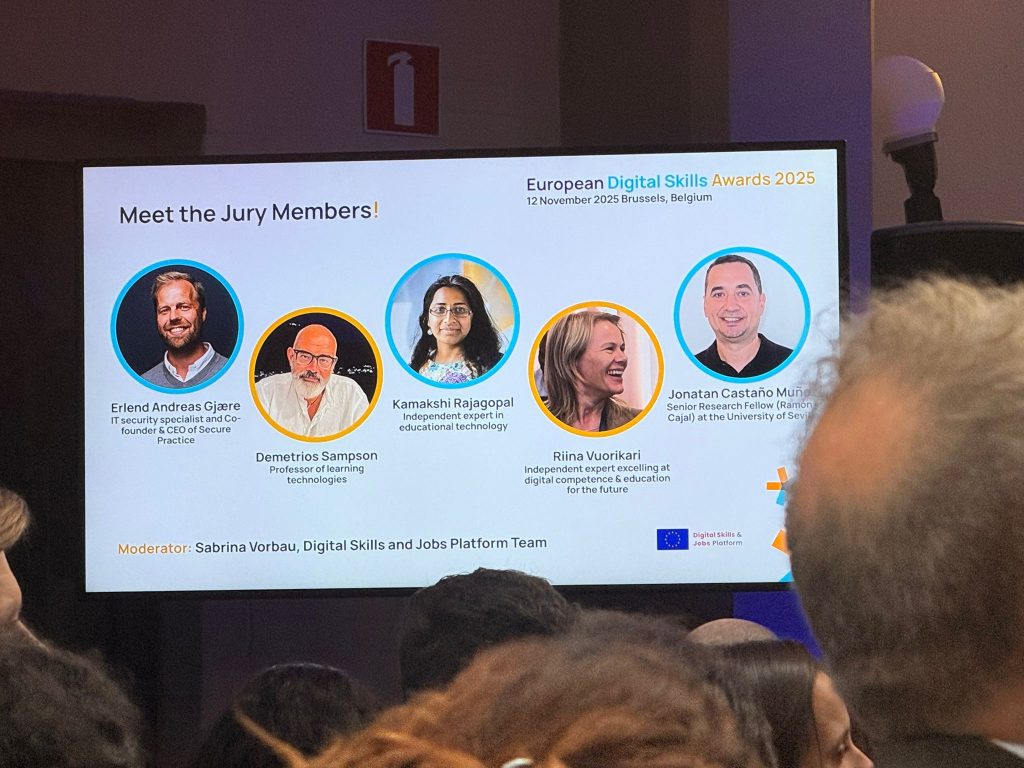
Yesterday (November12) at a conference on digital skills and inclusion, I listened to speaker after speaker talk about “digital skills for all.” Under the theme of inclusion, they spoke about grandparents learning to make video calls, about rural pensioners discovering online banking, about the miracle of access. No one mentioned Roma. No one spoke about the children growing up in neighborhoods where the internet still comes in bursts of signal, where laptops arrive as donations instead of expectations, and where the digital future is still someone else’s story.

When Europe talks about inclusion, it often imagines those who are almost inside already – the elderly, the rural, the undertrained. But not us. When policymakers talk about “catching up,” they picture the rest of society turning slightly backward to help someone a few steps behind, not looking sideways toward an entire community still waiting at the starting line, eager to fulfill their potential.

That is what segregation looks like in 2025. Not only the special school with a faded signboard, but the digital classroom without Roma children in it. Not only the physical wall, but the invisible one built by algorithms, connectivity, and the prejudice of low expectations.

Pushing the rest of society forward without accelerating Roma participation is another form of separation – digital segregation. It is quieter, more polite, and easier to justify. After all, no one is openly saying Roma should stay disconnected; they just don’t see us when designing policies, allocating funds, or defining “all.” They assume that digital inclusion will somehow trickle down to Roma communities. It won’t. Segregation never ends by accident.

The same blindness now appears in the digital sphere. The EU celebrates artificial intelligence, green transitions, and lifelong learning, but without targeted investment, Roma children will not enter that future. The next generation of coders, engineers, or designers are sitting in those Roma-only classrooms.. If Europe fails to connect them – literally and symbolically – it will repeat the old story of progress that leaves the same people behind.

Digital segregation is not about gadgets. It is about belonging. It asks who gets to participate in shaping tomorrow’s world and whose voice will be embedded in the algorithms, platforms, and policies we are building today. The question is not whether Roma can learn to use digital tools, but whether Europe can learn to design an inclusive digital society that expects Roma to be part of it from the start.

The D.H. ruling eighteen years ago taught us that segregation is often defended as efficiency or tradition, and that progress without equality is just a new form of injustice. The same principle applies now. Without deliberate action, the digital divide will become a digital wall – high-speed for some, no signal for others.

They don’t see us yet. Not because we are invisible, but because they are looking elsewhere,  toward the comfortable edges of inclusion. But every Roma child deserves to be seen as part of Europe’s digital future.

If Europe truly means “digital skills for all,” it must look again. This time, with open eyes.

The Password for the Future | Complementary Education Center (CEC) in Romania

Posted on October 28, 2025 by admin1

An editorial signed by Stanislav Daniel, team leader for CECs

This October, I crisscrossed five countries and set foot in five capitals, including the one I reside in, each with its own agenda, its own urgency. Policies debated. Priorities negotiated. Commitments renewed.

If I followed only my itinerary, I should remember the month by the sequence of events: first Brussels, then Bucharest, then Sofia, then further journeys where the calendar demanded my presence. But memory, I’m finding, has its own hierarchy. Because what stays with me is not the marble of conference venues or the polished language of official statements. It’s not even the applause lines meant to convince us that progress is underway.

What echoes particularly is a single room in Bucharest, full of life. A room where the air vibrated with children’s laughter and the stubborn determination of climbing up. A room where fall arrived early through paintbrushes dipped in orange and brown. A room where inclusion was not something far in the future, a bullet point in a plan, or a political promise, but something alive, immediate, present.

A Promise in Brussels

The month began in Brussels, at the European Platform for Roma Inclusion – a checkpoint of sorts, five years into the EU Roma Strategic Framework, which includes plans to improve education for Roma children. We listened to speeches that recognized both progress and the uncomfortable truth: change remains slow, especially in the places where needed it most.

I sat there with the familiar tension in my chest – pride in how far we’ve come, frustration at how far we still must go. Sitting at a podium next to the deputy minister, alumna of our scholarship program, I listened to leaders recognizing the pitfalls. They spoke of accountability, participation, the need for better data and stronger political will. They acknowledged that Roma must shape the policies that concern us.

And then it materialized

Mid-October can feel like a dull pause between seasons, but not inside REF’s first Complementary Education Center. The moment I stepped in, I felt the energy, a large room buzzing with determination and color.

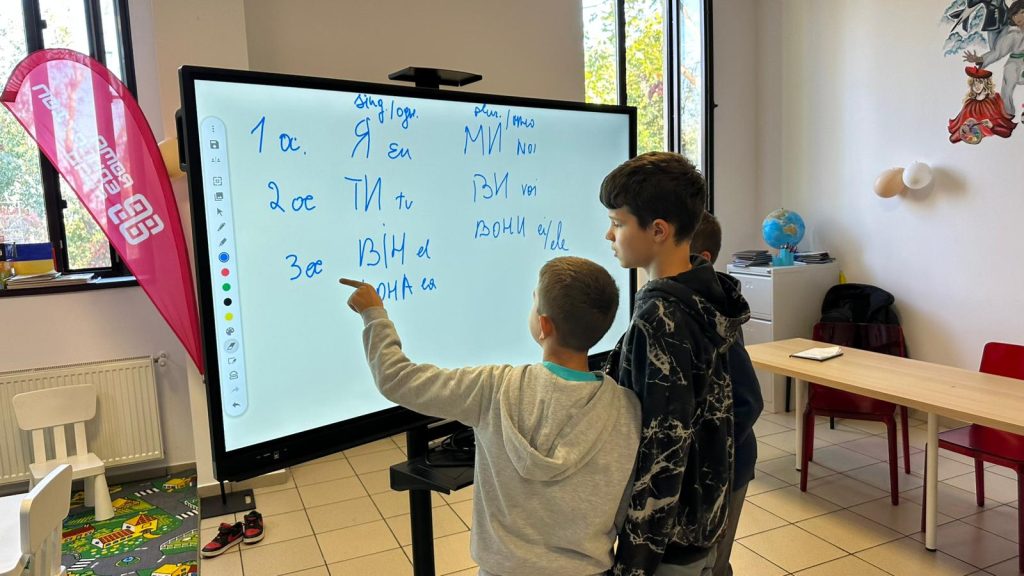
One side of the space was devoted to mathematics. Children – that day all of them originally from Ukraine, all of them carrying more than children should – leaned over notebooks, trying to catch up to a school system they never planned to join. Their instructor, Ukrainian herself, moved among them with quiet mastery, jumping over age gaps through patience and instinct. When Roman numerals appeared on the board –MCMLXXXIV – a chorus erupted:

“1984!”

The small victory felt like a proof that these kids will not give up!

Screen capture from the Romanian National Broadcaster’s program “Convețuiri,” featuring a story about the CEC.

A few meters away, autumn spilled across watercolor paper. Orange. Amber. Forest green. Here, another group, they weren’t refugees or statistics – just kids, making leaves fall from the trees and capturing movements, mastering stopping of time.

The Complementary Education Center model works because it starts where every child’s story begins — in their community, in their language, with respect for who they are.

Lived Experience

Watching those children learn, I felt something deeply familiar from literature, from our own plans, methodologies. Inclusion, for Roma, has never been a theoretical concept. We learned inclusion and resilience not from policy documents, but from the everyday struggle to belong. We became experts through what researchers might call rigorous participatory action – though most of the time, it simply meant surviving systems not built for us.

At the Platform in Brussels, leaders emphasized that Roma participation is not a favor – it is a democratic necessity, and progress depends on Roma shaping solutions.  I saw that truth right there among the children in Bucharest. This wasn’t charity. It wasn’t a project perfectly aligned to a funding call. It was a community responding to real needs with real knowledge – empathy translated into structure.

We’ll still have to fundraise to keep the activities alive. We’ll need to continue building relationships with authorities. But we know our motivation grows from the grassroots.

Future of Work

At the end of the month, in Sofia at the Future of Work Summit, I found fresh confidence. The agenda read like a mirror held up to our work: skills gaps, AI, digital transitions, inclusive talent pipelines. Because when you travel from policy rooms to classrooms, you ask: Are we aligned with the future? Here, the answer arrived with clarity.

I heard HR leaders say that talent will define cross-border competitiveness. I heard speakers insist that exclusion isn’t just a moral failure – it is a strategic risk. And I grew in confidence: the Complementary Education Center – the children learning, arts, numbers – they aren’t in the margins, they are part of the solution. We are on the right path.

 A Stronger Europe

Looking back, the month lined up like a map of Europe’s choices. Brussels showed what must be done.  Bucharest showed how it can be done. And Sofia showed why it can’t wait.

Together, they formed a simple equation: inclusion + education + skills = a stronger Europe. The Complementary Education Center isn’t just a support program. It is the infrastructure for the next economy — built at child-height, painted in watercolors, and measured in possibilities.

When I think of October now, I don’t see conference agendas or PowerPoint slides. I see a room where children shouted “1984!” like it wasn’t a year in the past but a password to the future. I see leaves painted in colors the world hasn’t named yet. I see the quiet determination of a teacher building bridges faster than policy cycles.

Europe keeps asking how to accelerate change, how to turn strategies into results, how to prepare for the future of work, how to defend growth in a shrinking demographic horizon. The answer is not abstract. It is sitting in that room, pencil tapping, eyes focused, waiting for the world to notice.

If we choose to believe in those children, to invest in their education, trust their talent, honor their identity, then inclusion stops being a promise. It becomes Europe’s smartest bet on its own future.

Stay connected

Initial Founders

The World Bank

An international financial institution that provides loans and grants to the governments of low- and middle-income countries for the purpose of pursuing capital projects.
The World Bank

Open Society Foundations

Financially supports civil society groups around the world, with the stated aim of advancing justice, education, public health and independent media.
Open Society Foundations