
Roma are the Growth Engine the Western Balkans Can’t Afford to Ignore
Posted on October 13, 2025 by admin1
By Marina Savković, Team Leader for Skills & Employment, Roma Education Fund
The World Bank has sounded the alarm and the Western Balkans should be paying attention. Growth is running on borrowed time. With half the region’s talent sitting on the sidelines, prosperity is hitting a demographic wall. The numbers are blunt: a looming shortfall of 190,000 workers, and entire groups (women, young people, older adults) still missing from the labour market. The takeaway couldn’t be clearer: getting Roma into work isn’t just social policy, it’s smart economics.
At the Roma Education Fund, we’re ready to scale up that activation, not as an add-on, but as a core driver of regional growth. Education is the foundation, employment the bridge. Bring them together, and Roma inclusion can shift from the margins to the mainstream. The only question now is whether policymakers will seize the moment or keep hitting snooze on the region’s wake-up call.
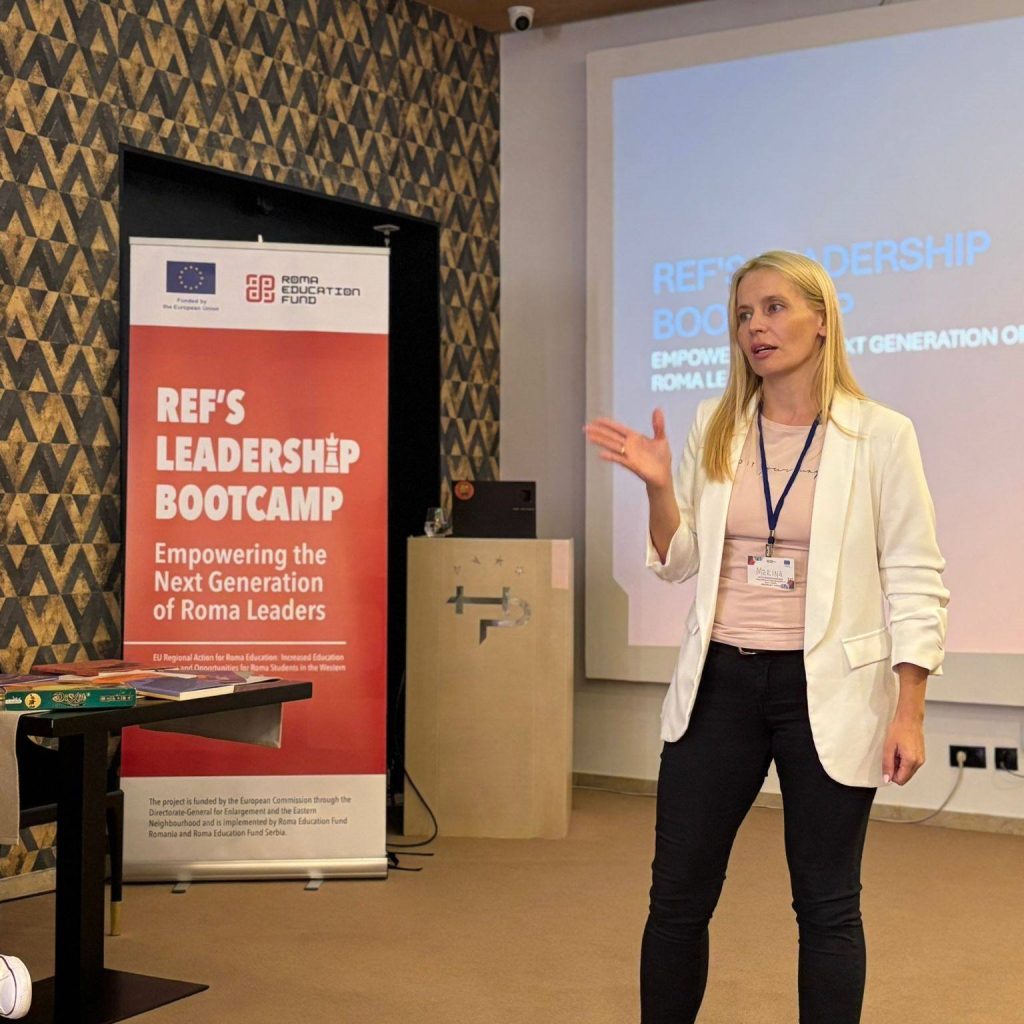
Roma Inclusion as a Growth Accelerator – Why labour markets must no longer ignore us
The World Bank’s new report Jobs Critical to Sustaining Growth in the Western Balkans delivers a serious message: the region is heading into a labour crunch. Over the next five years, the Western Balkans could face a shortfall of more than 190,000 workers if current demographic and labour market trends persist. Meanwhile, unemployment across the region stays above 10 percent, and labour force participation hovers below 55 percent — with women, youth, and older adults as the most under-represented groups.
These figures are not abstract. They validate what REF and many practitioners have observed on the ground for years: excluding any large group from education and employment is a growth risk. If the Western Balkans wants to compete, it must start seeing Roma as an essential strategy for workforce expansion and resilience.

How the World Bank’s Findings Echo REF’s New Mission?
The Bank’s Jobs Critical to Sustaining Growth in the Western Balkans report identifies the same structural challenges that REF has been addressing for years and points to solutions that lie at the heart of our programs.
First, the World Bank underlines a paradox: even with high unemployment, employers can’t find the workers they need. The problem isn’t a lack of people, it’s barriers in skills, access, and inclusion. These are exactly the barriers REF’s education and employability work seeks to dismantle.
Second, it emphasizes the need to activate underrepresented groups, particularly women, youth, and older adults. These groups often face multiple barriers to entering the labor market. Roma youth, positioned at the intersection of these vulnerabilities — young, marginalized, and often excluded on ethnic grounds — are among those most affected, and most in need of targeted activation.
Third, the report warns of a sharp demographic decline, projecting that the working-age population in the Western Balkans could shrink by nearly 20 percent by 2050. This trend makes the activation of all available human capital — including Roma communities — not only desirable, but indispensable.
Finally, the Bank calls for structural reforms to boost participation and productivity: greater investment in foundational education and health, stronger labour-market inclusion, digital and green skills development, and business environments that attract private capital.
In essence, the World Bank is underscoring exactly what REF has long advocated: that bridging the gap between marginalized communities and the core economy is not charity, but smart economic policy and a precondition for sustainable growth.

How REF’s Approach Responds and What We Propose for Scaling?
Over the past two decades, REF has built robust educational and support systems for Roma children and youth: scholarships, inclusive pedagogy, mentoring, public advocacy, and capacity strengthening in partner schools. That foundation is essential but not sufficient. Education must lead to sustainable livelihoods.
That is why REF now pivots toward employability and activation. Our Skills & Employment strategic program is designed to offer relevant, market‐oriented training in sectors where growth and demand are emerging: digital, green economy, technical trades, service industries. We are building stronger linkages between trainees and employers, embedding mentorship, internships, and job placement support.
In doing so, we anchor our strategy in local realities: capturing sectoral data, consulting with employers, adjusting training curricula to evolving needs, and monitoring which interventions result in sustainable employment. We aim for measurable outcomes not only “number of workshops held,” but number of Roma youth placed in real, dignified jobs.
By aligning public policies, employer initiatives, and community action, Roma employability can move from the margins into the mainstream. Together — governments, businesses, and organizations like REF — we can turn inclusion into one of the Western Balkans’ strongest competitive advantages.

